REVIEW · HO CHI MINH CITY
Saigon: City Sightseeing Hop-On Hop-Off Bus Tour
Book on GetYourGuide →Operated by City Sightseeing Worldwide · Bookable on GetYourGuide
A city bus that helps you read Saigon fast.
This hop-on hop-off tour gives you two daytime loops so you can pace the sights in Ho Chi Minh City at your own speed, with audio that explains what you’re seeing. The route is built around major landmarks like Notre Dame Cathedral, the War Remnants Museum, and Ben Thanh Market, so you’re not guessing where to start.
I love the free Wi‑Fi and the included guidebook with maps and recommendations. I also like that the red and blue routes cover different sides of town, so one pass can turn into a smart first-day overview. The main drawback: the audio is recorded, and some riders report occasional sound or headphone issues, plus moments where the commentary doesn’t perfectly match the exact buildings outside your window.
If you’re short on time, this bus is a practical way to stack key District 1 sights and then keep going into other areas without planning a full walking route. Expect frequent departures from the Opera House area (your starting point), and quick hop-offs that make it easy to turn sightseeing into photos, then shopping or museum time.
In This Review
- Key things to know before you ride
- The Saigon hop-on hop-off setup: two routes, one easy plan
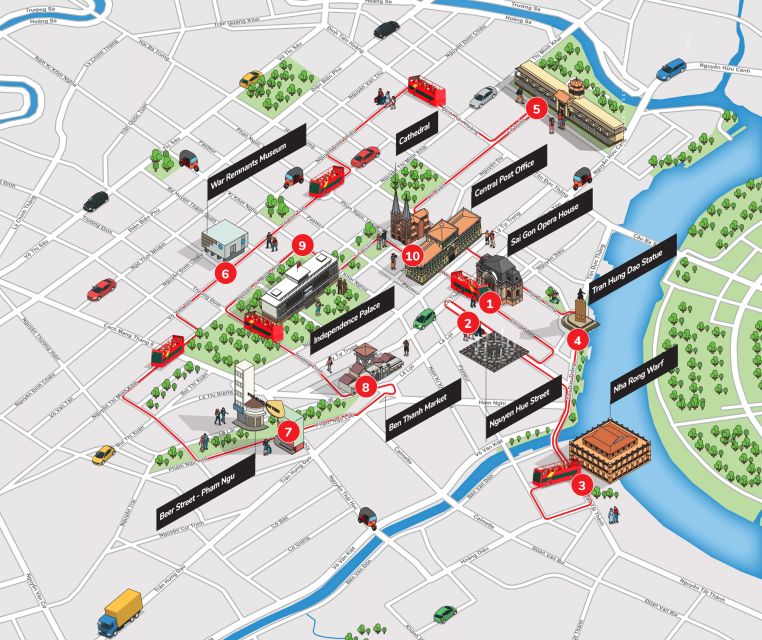
- Red Route: French colonial highlights and the big museum cluster
- Saigon Opera House (Stop 1)
- Nguyen Hue Street (Stop 2)
- Nha Rong Wharf (Stop 3)
- Tran Hung Dao Statue (Stop 4)
- Museum of Vietnamese History (Stop 5)
- War Remnants Museum (Stop 6)
- Pham Ngu Lao Street (Stop 7)
- Ben Thanh Market (Stop 8)
- Independent Palace (Stop 9)
- Saigon Notre Dame Cathedral / Central Post Office (Stop 10)
- Blue Route: markets, pagodas, and the Ha Noi-to-Scotland problem (aka which side?)
- Beer Street – Pham Ngu Lao Street (Stop 1)
- Ben Thanh Market (Stop 2)
- War Remnants Museum (Stop 3)
- Ho Thi Ky Flower Market (Stop 4)
- Phuoc An society’s premises (Stop 5)
- Ong Bon Pagoda (Stop 6)
- Binh Tay Market (Stop 7)
- Thien Hau Pagoda (Stop 8)
- Van Phat Pagoda (Stop 9)
- How to use the 1-day or 2-day pass without wasting time
- Comfort, views, and the real-world sound check
- Price and value: when this pass wins and when taxis might
- Guides, entertainment, and why staff matter
- Stop-by-stop game plan: what I’d prioritize on your first day
- Should you book the Saigon hop-on hop-off bus?
- FAQ
- How long is each bus route?
- How often do the buses run, and what are the first and last departures?
- Can I buy a 1-day or 2-day pass?
- Do they accept mobile vouchers and paper vouchers?
- Where can I exchange my ticket voucher?
- What languages is the audio guide available in?
Key things to know before you ride

- Two connected loops (Red + Blue) help you avoid crisscrossing the city
- Headset audio in 9 languages keeps you oriented even when street signs are confusing
- Frequent buses (Red every 30 minutes; Blue every 45 minutes) reduce waiting time
- Weather and sun support: staff have been known to hand out ponchos and hats, and you can ride downstairs in aircon
- Fast ticket exchange: you can swap vouchers at the counter beside Saigon Opera House, facing the Continental Hotel
The Saigon hop-on hop-off setup: two routes, one easy plan

I like how this tour treats your time like a choice, not a schedule. You get a 1-day or 2-day pass, and you’re meant to ride, hop off for an hour or two (or just a photo stop), then climb back on the next bus.
Both routes start at Stop 1 near the Saigon Opera House area, so you’re not hunting around different starting points. From there, the tour splits into two different experiences: the Red Route leans into classic central landmarks and museums, while the Blue Route pushes farther toward markets and pagodas.
You’ll also get audio commentary with headphones in nine languages: English, Spanish, German, French, Chinese, Japanese, Korean, Vietnamese, and Russian. Even if you miss some details, you’ll still get the rhythm of where things sit and how the city connects.
You can also read our reviews of more city tours in Ho Chi Minh City



Red Route: French colonial highlights and the big museum cluster
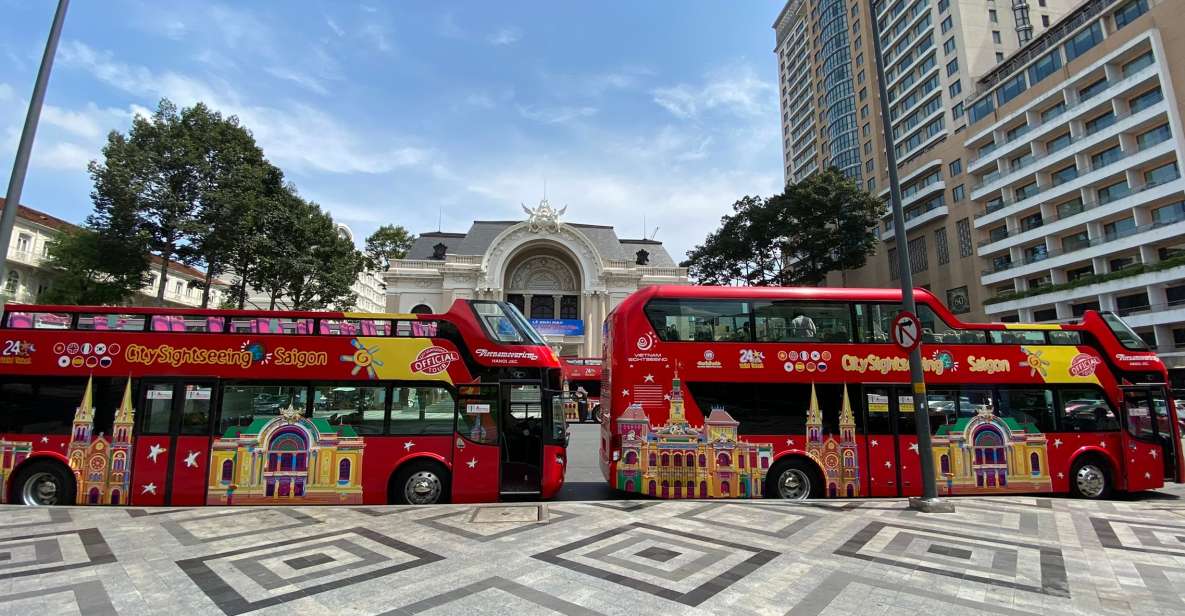
The Red Route runs a loop of about 75 minutes, with buses leaving about every 30 minutes. First departure is 9:00am from Stop 1, and the last departure from Stop 1 is 4:00pm. That timing is handy if you’re doing your sightseeing before dinner.
Here’s the Red Route in the order you’ll see it, and how I’d use it:
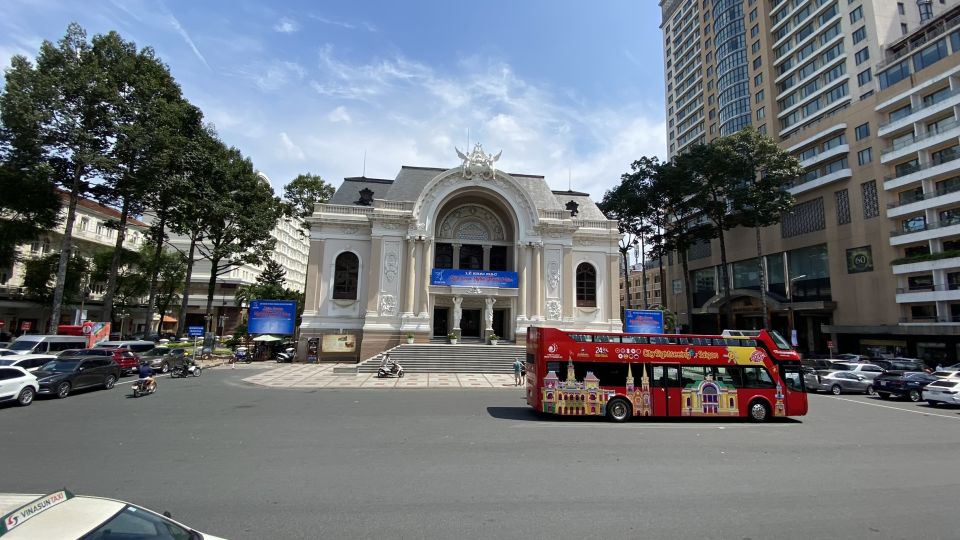
Saigon Opera House (Stop 1)
This is your anchor point. It’s a solid place to start because it’s central and easy to find, and it’s also the spot where tickets can be exchanged. If you’re arriving in the morning, starting here makes the rest of your day simpler.
Nguyen Hue Street (Stop 2)
This is one of those main-street moments where you can get your bearings fast. From the open-top perspective, it’s a good area to get skyline and street layout photos without walking the heat.
Nha Rong Wharf (Stop 3)
A waterfront-feeling stop that works well if you like seeing the city’s edges, not just the center. It’s also a nice pause if you want a shorter hop-off and then continue before your feet get tired.



Tran Hung Dao Statue (Stop 4)
Another quick landmark stop. Use it as a photo break and a reset—then you’re back on the bus to keep the loop moving.
Museum of Vietnamese History (Stop 5)
If you want a museum with less guesswork, this stop helps. You’ll be close enough to decide whether you’re in the mood for an indoor visit, then return without worrying about transit.
War Remnants Museum (Stop 6)
This is one of the Red Route’s main payoff stops. If you’re going to prioritize just one museum area, I’d put your “serious time” here. The buses run often enough that you can do the museum at a slower pace and still catch another loop.
Pham Ngu Lao Street (Stop 7)
This area is a practical shopping and browsing zone. Even if you’re not staying for long, it’s a good hop-off point to break up your day with local-life energy.
Ben Thanh Market (Stop 8)
Ben Thanh Market is one of the stop names that matters most for first-time visitors. It’s the kind of place where you can hunt for souvenirs and also grab a bite, since it’s known for food and shopping in one place. If you need one market stop that covers a lot of variety, this is the one.
Independent Palace (Stop 9)
A must-do for many people who come to the city. What I like about this stop is that it’s a clean “decide and go” moment—off for your visit, then back on to continue the Red Route or switch plans.
Saigon Notre Dame Cathedral / Central Post Office (Stop 10)
This combined stop is great for classic-photo duty. You’ll see two very recognizable structures tied to the colonial-era look, and the bus perspective helps you understand spacing between buildings before you walk around.
Blue Route: markets, pagodas, and the Ha Noi-to-Scotland problem (aka which side?)
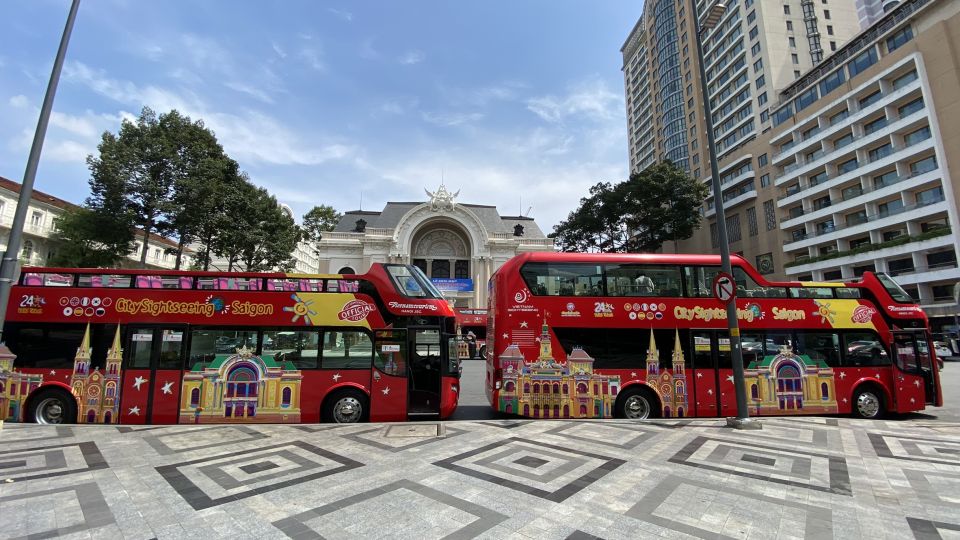
The Blue Route loop takes about 80 minutes, with buses every 45 minutes. First departure is 9:00am, and the last departure from Stop 1 is 3:45pm. The earlier last departure is why I suggest using Blue Route for a full morning or early afternoon block.
This line is useful when you want the city beyond the central postcard zone. It also includes stops that overlap with Red Route, which makes switching plans easier.
Here’s the Blue Route, in order:
Beer Street – Pham Ngu Lao Street (Stop 1)
This is a useful starting point if your energy is leaning toward nightlife areas or casual browsing. Even if you’re not planning an evening drink, it helps you orient yourself around a busy, central strip.
Ben Thanh Market (Stop 2)
Yes, it’s also on the Blue Route. That’s not a mistake—it’s there so you can revisit or anchor your shopping time if you didn’t get enough on the Red Route.
War Remnants Museum (Stop 3)
Again, it overlaps. This makes it easier to match your day to your museum stamina: if you started Red and didn’t want to jump off at the museum, you can catch it here.
Ho Thi Ky Flower Market (Stop 4)
A straightforward market stop for color, photos, and gift-hunting. I’d treat it as a time-boxed hop-off—spend 30 to 60 minutes, grab what you want, then get back on before you lose the bus rhythm.
Phuoc An society’s premises (Stop 5)
A named stop that’s basically there so you can reach a specific place efficiently. If it’s on your list, this is one of the easiest ways to get close without figuring out routes from scratch.
Ong Bon Pagoda (Stop 6)
A temple stop that’s ideal if you want a different kind of Saigon scene than the streets and museums. The bus helps you reach it quickly, and you can decide how long to stay based on your interests.
Binh Tay Market (Stop 7)
Another market option beyond Ben Thanh. If you’re into comparing stalls and shopping vibes, this is your chance. If you’d rather keep your time for one market, you can skip this and focus on Ben Thanh.
Thien Hau Pagoda (Stop 8)
A second pagoda stop on Blue Route. If you like visiting religious sites, you’ll appreciate that Blue Route gives you more than one temple-adjacent stop.
Van Phat Pagoda (Stop 9)
The third pagoda stop. This is good for a “check them off, then move on” style day. It also means Blue Route can work even if you’re not shopping much—you’re still getting variety.
How to use the 1-day or 2-day pass without wasting time
The tour is designed for unlimited hop-on hop-off within 1 to 2 days, and that’s where the value shows up. If you buy a pass and then stay on the bus the whole time, you might feel like you overpaid. But if you treat it like a flexible transit tool—ride, hop off, return, repeat—you’ll get your money’s worth.
A smart rhythm:
- Do one full loop (Red or Blue) first to build a mental map.
- Then pick 2 to 4 stops you actually want to spend time on.
- Use the overlap at Ben Thanh and the War Remnants Museum to adjust your pace.
Also, here’s a practical tip built into the system: you’re advised to switch lines at Stops 6, 7, and 8 on the Red Route, which correspond to Stops 1, 2, and 3 on the Blue Route. That’s useful when you want to move from the central museum/shopping area toward the markets and pagodas without doubling back.
Timing matters too. With Red Route buses every 30 minutes and Blue every 45 minutes, you can plan short hop-offs without feeling trapped. Still, the Blue Route has a tighter end window (last departure 3:45pm), so I’d avoid leaving it for late afternoon.
Comfort, views, and the real-world sound check
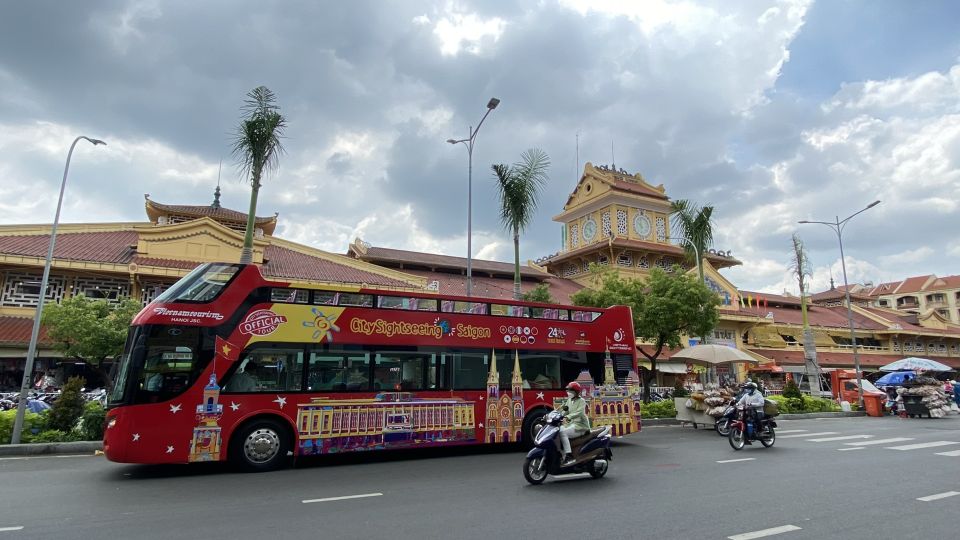
The top deck view is the reason most people enjoy these rides. You’ll get a higher, easier photo angle and a smoother sense of how the city lays out. If it’s hot, you can sit downstairs where some buses offer air conditioning—an easy quality-of-life move.
On the comfort side, I’ve seen mentions of staff giving out ponchos during rain and hats when the sun is strong. That’s the kind of small help that makes a difference in a city where weather can switch fast.
Sound is the wildcard. The audio is recorded and delivered through headphones, and that’s convenient—no tour-group shouting over traffic. But a few riders have reported headphone issues or volume problems, and some mention the audio may not perfectly sync with what you see outside at certain moments. My advice: keep your expectations realistic. Treat the audio as guidance, not a movie where every frame matches.
Also, there’s a practical reality in a loud city: if you’re struggling to hear, try turning your volume up on your device/player (if available) and sit closer to the speaker area where possible. And if you notice sound dropping mid-ride, ask the staff right away.
Price and value: when this pass wins and when taxis might

At $21 per person for a 1–2 day pass, this tour can be good value when you plan to use it more like a toolkit than a single ride. The big advantage is frequency and coverage: it’s a low-stress way to hit several major sights across different neighborhoods without negotiating traffic or waiting for rides.
That said, some people compare it to point-to-point taxis and feel it’s not cheaper than getting around directly. If your plan is just to visit one or two places and then go back to your hotel, a hop-on pass might feel like overkill.
My rule of thumb:
- Book it if you want a broad overview, multiple stops, and an easy day plan.
- Skip it (or be selective) if you already know exactly where you’re going and you’ll only stop at one or two locations.
Where it shines is when you combine the museum-and-market stops with classic architecture spots, then use the overlap to adjust on the fly.
Guides, entertainment, and why staff matter
Even with recorded audio, the people on the ground can make or break the experience. In the feedback I saw, names like Lockie, Tom, Tuon, and Pham came up as standout guides for making the bus ride feel more alive through their explanations and humor.
There’s also the behind-the-scenes help: staff have been described as friendly and quick to solve problems like rain protection needs, and they’ve been noted for helping riders find the right bus when there are multiple stops nearby. That’s important because in a city with constant movement, easy wayfinding is half the battle.
Stop-by-stop game plan: what I’d prioritize on your first day
If you want a simple approach that works for most visitors, I’d build your first day around the core central stops, then use the second day (if you have it) for markets and pagodas.
A practical first-day list:
- Start at Saigon Opera House and ride Red Route for orientation.
- Hop off at the War Remnants Museum when you’re ready to commit time.
- Do Ben Thanh Market for souvenirs and food.
- End the Red Route with the Notre Dame Cathedral / Central Post Office area for that classic-photo payoff.
For day two (or a second block if you don’t have 2 days):
- Use Blue Route to expand into Ho Thi Ky Flower Market and the pagodas.
- Include Binh Tay Market if you like comparing shopping areas.
- Revisit Ben Thanh if you want more time than you gave it the first day.
If you’re visiting with limited mobility or small kids, this style helps because you can get off only when you want to walk, then retreat back to the bus when you need a break. For everyone else, it keeps you from turning a sightseeing day into a logistics day.
Should you book the Saigon hop-on hop-off bus?

If you want an easy, flexible way to cover major Ho Chi Minh City sights—especially the museum cluster, Ben Thanh, and classic architecture—this is a strong choice. The two-route system helps you spread your day across neighborhoods without overplanning, and the headset audio in nine languages plus free Wi‑Fi makes it work even when you’re trying to get oriented quickly.
I’d be more cautious if you’re the type who hates recorded commentary or you’re very sensitive to audio syncing and equipment reliability. In that case, treat the ride as visual orientation first, and plan to use hop-offs for the real priorities.
Overall: for a first-time Saigon trip with more than one thing on your list, this is the kind of ticket that reduces stress and maximizes options.
FAQ
How long is each bus route?
The Red Route takes about 75 minutes, and the Blue Route takes about 80 minutes.
How often do the buses run, and what are the first and last departures?
Red Route: every 30 minutes, first departure at 9:00am and last departure at 4:00pm from Stop 1.
Blue Route: every 45 minutes, first departure at 9:00am and last departure at 3:45pm from Stop 1.
Can I buy a 1-day or 2-day pass?
Yes. Your ticket can be valid for 1 day or 2 days.
Do they accept mobile vouchers and paper vouchers?
Yes. Both mobile and paper vouchers are accepted.
Where can I exchange my ticket voucher?
You can exchange vouchers at the ticket counter beside the Saigon Opera House, facing the Continental Hotel.
What languages is the audio guide available in?
The audio guide is available in English, Spanish, German, French, Chinese, Japanese, Korean, Vietnamese, and Russian, and it includes headphones.